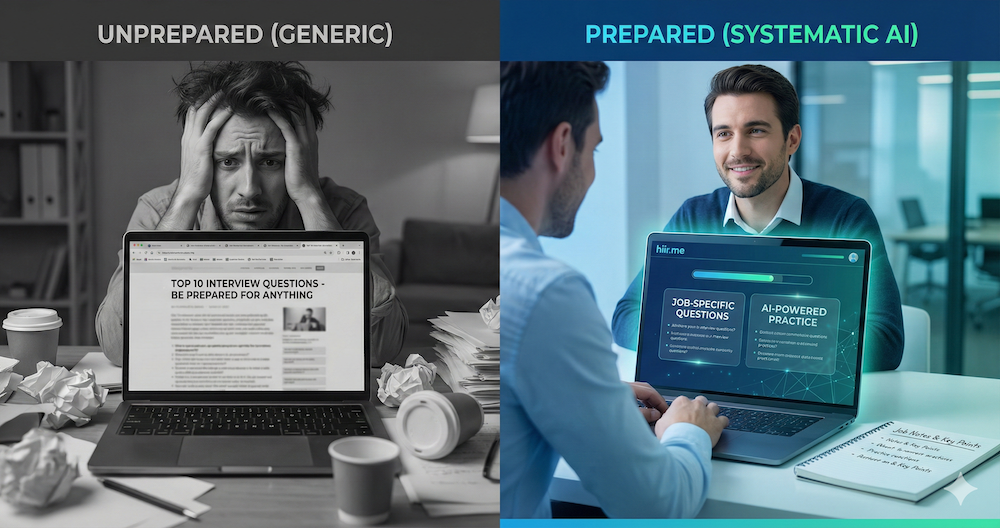
Unprepared versus prepared job interview candidate showing difference between generic and systematic AI-powered interview preparation
How to Prepare for Job Interviews: AI-Powered Question Practice System
You got the interview. Congratulations! You're already ahead of 95% of applicants.
Now what?
Most candidates do one of two things:
Option 1: Wing it. They figure "I know my experience, I'll just answer questions as they come." Then they freeze when asked "Tell me about a time you handled conflict" and ramble for 3 minutes with no clear answer.
Option 2: Generic prep. They Google "top 10 interview questions" and practice answers to questions that won't even be asked. They prepare for "What's your biggest weakness?" when the actual interview focuses on technical scenarios specific to the role.
Both approaches fail for the same reason: They're not practicing the actual questions they'll be asked for this specific job.
Here's what actually works: Practice job-specific questions with AI feedback before the interview.
In this guide, I'll show you exactly how to prepare for interviews systematically using AI-powered practice that mimics the real interview experience.
⏱️ TL;DR
Stop practicing generic interview questions. Generate 10-15 job-specific questions based on the actual job description and your background, practice answering them with AI coaching feedback, and focus on the STAR method for behavioral questions. Most candidates spend 30 minutes preparing; top performers spend 3-4 hours on targeted practice.
Why Generic Interview Prep Doesn't Work
You've seen the articles: "Top 20 Interview Questions" or "Most Common Interview Questions in 2025."
The problem? Those questions are too generic to prepare you for your specific interview.
Here's what actually happens in interviews:
For a Software Engineer role:
- "Walk me through how you'd design a scalable API for our mobile app"
- "Tell me about a time you optimized database performance"
- "How do you approach code reviews when you disagree with a senior developer?"
For a Marketing Manager role:
- "How would you develop a go-to-market strategy for a B2B SaaS product?"
- "Describe a campaign where your initial hypothesis was wrong. What did you do?"
- "How do you balance brand awareness versus lead generation in budget allocation?"
For a Customer Success role:
- "A customer is threatening to churn due to a product limitation. Walk me through your approach"
- "How do you prioritize when managing 50+ accounts with varying needs?"
- "Tell me about a time you turned a detractor into a promoter"
Notice something? These questions are specific to the role, the company's situation, and your background.
Generic prep doesn't help you answer these. You need targeted practice.
The Interview Preparation Gap
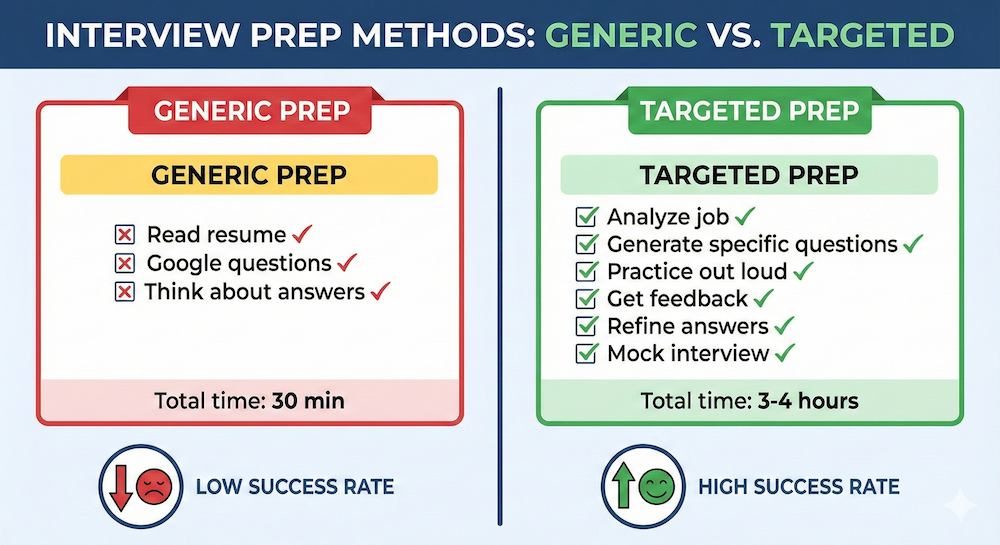
Most candidates prepare like this:
- Read the job description once (maybe)
- Review their own resume
- Google "common interview questions"
- Think about answers in their head (never practice out loud)
- Show up hoping for the best
Total prep time: 30 minutes
Top performers prepare like this:
- Analyze job description deeply (requirements, priorities, company challenges)
- Generate 10-15 job-specific questions they're likely to be asked
- Practice answers out loud with feedback
- Refine weak answers
- Prepare questions to ask the interviewer
- Do a mock interview
Total prep time: 3-4 hours
Guess which group gets offers?
The difference isn't talent. It's preparation quality.
If you've been getting interviews but no offers, this is why. The good news? This is completely fixable.
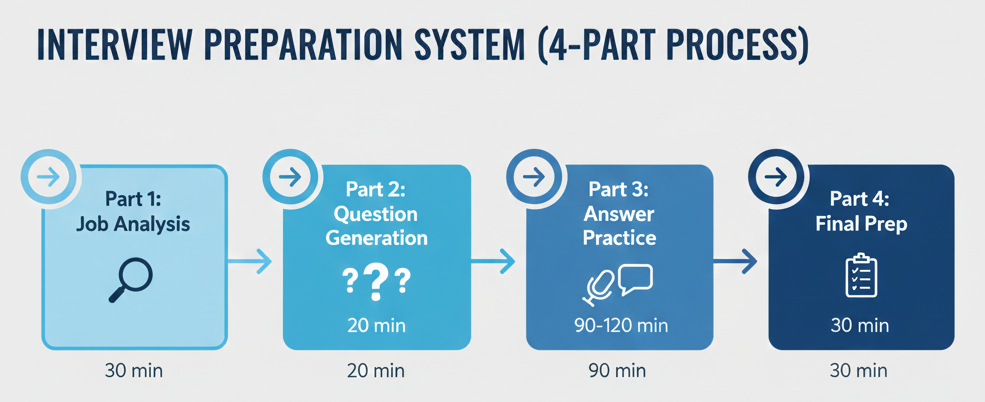
The 4-Part Interview Preparation System
Here's the systematic approach that works:
Part 1: Job Analysis (30 minutes)
Before you can prepare, you need to understand what they're actually evaluating.
What to analyze:
- Required skills - What technical/functional skills do they emphasize?
- Key responsibilities - What will you be doing day-to-day?
- Company challenges - What problems are they hiring you to solve?
- Culture indicators - What type of person succeeds here?
- Experience level - Are they hiring a doer, a leader, or both?
How to do this:
- Re-read the job description and highlight key phrases
- Research the company (recent news, product launches, challenges)
- Check LinkedIn to see what the team looks like
- Read Glassdoor interview reviews for this company
- Identify the top 3 things they care most about
Output: A clear picture of what this specific role needs and what they'll ask about.
Part 2: Question Generation (20 minutes)
Now generate the actual questions you'll likely face.
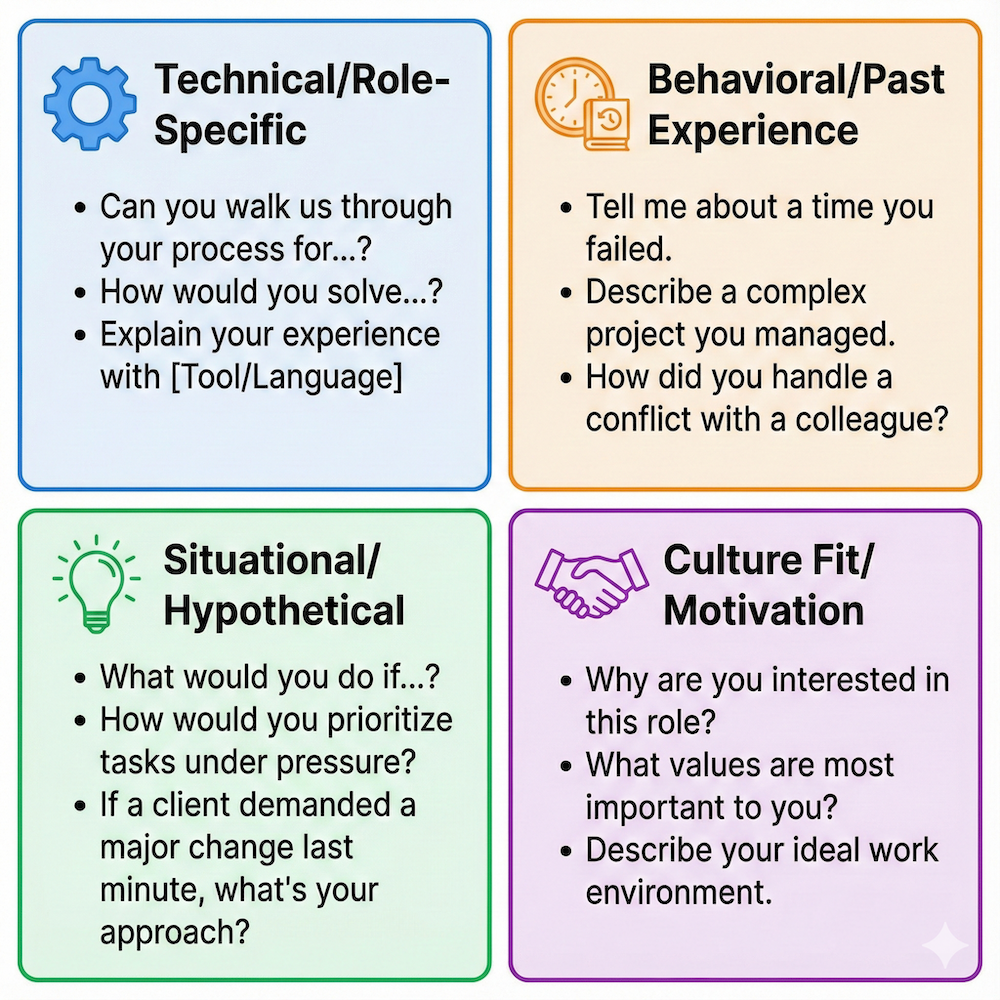
Four question categories to prepare:
1. Technical/Role-Specific (3-5 questions)
- Skills-based questions about your domain expertise
- Scenario-based problems you'd encounter in the role
- How you approach specific types of work
Example for Data Analyst:
- "Walk me through how you'd analyze our customer churn data"
- "What's your process for validating data quality?"
- "How do you decide which visualization type to use?"
2. Behavioral/Past Experience (4-6 questions)
- "Tell me about a time..." questions
- How you've handled specific situations before
- Your work style and approach
Example for any role:
- "Tell me about a time you missed a deadline. What happened?"
- "Describe a situation where you had to influence someone without authority"
- "Give me an example of when you received critical feedback. How did you respond?"
3. Situational/Hypothetical (2-3 questions)
- "What would you do if..." questions
- How you'd handle challenges specific to this company
- Your problem-solving approach
Example for Project Manager:
- "You have 3 urgent priorities and can only complete 1 this week. How do you decide?"
- "A stakeholder disagrees with your project timeline. How do you handle it?"
4. Culture Fit/Motivation (1-2 questions)
- Why this company/role
- Your career goals
- What motivates you
Standard questions:
- "Why are you interested in this role?"
- "Where do you see yourself in 3-5 years?"
- "Why are you leaving your current position?"
How to generate these questions:
Manual method:
- Look at each requirement in the job description
- Turn it into a question: "Experience with X" becomes "Tell me about your experience with X"
- Add behavioral questions related to key responsibilities
- Include 2-3 situational questions about challenges mentioned in the job description
AI-powered method (faster and more accurate):
Use AI to generate questions specific to this job and your background. At Hiir.me, our interview prep feature does this automatically:
- Input the job description
- AI analyzes requirements and company context
- Generates 10-15 tailored questions across all 4 categories
- Explains why each question is likely to be asked
- Suggests key points to address in your answer
This saves you the guesswork and ensures you're practicing the right questions.
Part 3: Answer Practice with Feedback (90-120 minutes)
This is where most people fail. They think about their answers but never practice them out loud.
Why practicing out loud matters:
- What sounds good in your head often rambles when spoken
- You discover gaps in your examples
- You learn to control timing (60-90 seconds is ideal for most answers)
- You build confidence and reduce anxiety
The practice process:
Round 1: First attempt (30-40 minutes)
- Set a timer
- Read the question
- Answer out loud as if in the real interview
- Record yourself (audio or video - uncomfortable but essential)
- Move to next question
Don't judge yourself yet. Just get your first answers recorded.
Round 2: Review and feedback (30-40 minutes)
Listen to each answer and evaluate:
- Clarity: Could someone understand your point?
- Structure: Did you have a clear beginning, middle, end?
- Relevance: Did you directly answer the question?
- Specificity: Did you use concrete examples and numbers?
- Length: Was it 60-90 seconds or did you ramble?
AI-powered feedback (recommended):
Instead of self-evaluation (which is often inaccurate), use AI to analyze your practice answers.
At Hiir.me, our AI interview coach:
- Evaluates answer structure and clarity
- Identifies missing key points
- Checks if you're addressing what the question actually asks
- Suggests improvements for weak responses
- Rates your readiness for each question
This is like having a professional interview coach without the $200/hour cost.
Round 3: Refine and re-practice (30-40 minutes)
- Take the 3-5 weakest answers
- Revise based on feedback
- Practice them again out loud
- Compare to your first attempt
- Repeat until you're confident
Critical rule: Don't memorize word-for-word. You'll sound robotic. Instead, memorize the structure and key points, then let it flow naturally.
Part 4: Final Preparation (30 minutes)
1. Prepare questions to ask them (5-7 questions)
They'll ask "Do you have any questions?" This is a test, not a courtesy.
Good questions show you're strategic:
- "What does success look like in this role in the first 90 days?"
- "What are the biggest challenges the team is facing right now?"
- "How does this role contribute to [specific company goal you researched]?"
- "What's the team dynamic like? How do you collaborate?"
- "What opportunities for growth exist in this role?"
Avoid these questions (they make you look lazy):
- "What does your company do?" (You should already know)
- "What's the salary range?" (Save for later stages)
- "How much vacation time?" (Not the priority right now)
- "When will I hear back?" (They'll tell you)
2. Prepare your closing statement
When they ask "Is there anything else you'd like to add?" don't say "No, I think we covered everything."
Use this template:
"Yes - I want to reiterate my strong interest in this role. Based on our conversation, I'm even more convinced that my experience with [specific skill] and my approach to [relevant challenge] would allow me to contribute immediately to [specific team goal]. I'm excited about the opportunity and look forward to next steps."
3. Do a full mock interview (if possible)
If you have a friend or mentor available, run through the full interview with them asking your prepared questions.
If not, record yourself answering all questions in one sitting as if it's the real interview.
The STAR Method: Structure That Works
For behavioral questions ("Tell me about a time..."), use the STAR method:
S - Situation: Set the context (1-2 sentences)
T - Task: What was your responsibility? (1 sentence)
A - Action: What did YOU do? (3-4 sentences - this is the meat)
R - Result: What was the outcome? (1-2 sentences with numbers if possible)
Bad Answer (No Structure):
"Oh yeah, I've dealt with difficult stakeholders before. I'm really good at communication. One time I had this project where the stakeholder kept changing requirements, and it was really frustrating, but I managed to keep the project on track. I think communication is really important in these situations. I always try to keep everyone updated..."
Problems:
- No clear structure
- Vague and rambling
- No specific actions described
- No measurable result
- Too much filler ("I think," "really," "I always")
Good Answer (STAR Structure):
"[Situation] In my last role, I was leading a website redesign project when our primary stakeholder - the VP of Marketing - started requesting major scope changes 3 weeks before launch.
[Task] My responsibility was to deliver the project on time while maintaining stakeholder satisfaction and not burning out my team.
[Action] I scheduled a 1-on-1 with the VP to understand the underlying concerns driving the changes. I learned they were worried about mobile performance. Instead of implementing all their requests, I proposed a phased approach: we'd launch the core redesign on schedule, then address mobile optimization in phase 2 with proper testing. I created a detailed timeline showing how this approach would actually deliver better results than rushing changes. I also set up weekly check-ins so they felt involved without derailing daily progress.
[Result] We launched on time, the VP was happy with the phased approach, and mobile optimization increased conversions by 23% when we completed phase 2. The VP later told my manager I had 'the best stakeholder management skills on the team.'"
Why this works:
- Clear structure (easy to follow)
- Specific situation (not vague)
- Detailed actions (shows how you think)
- Measurable result (23% increase + positive feedback)
- Shows multiple skills (communication, problem-solving, leadership)
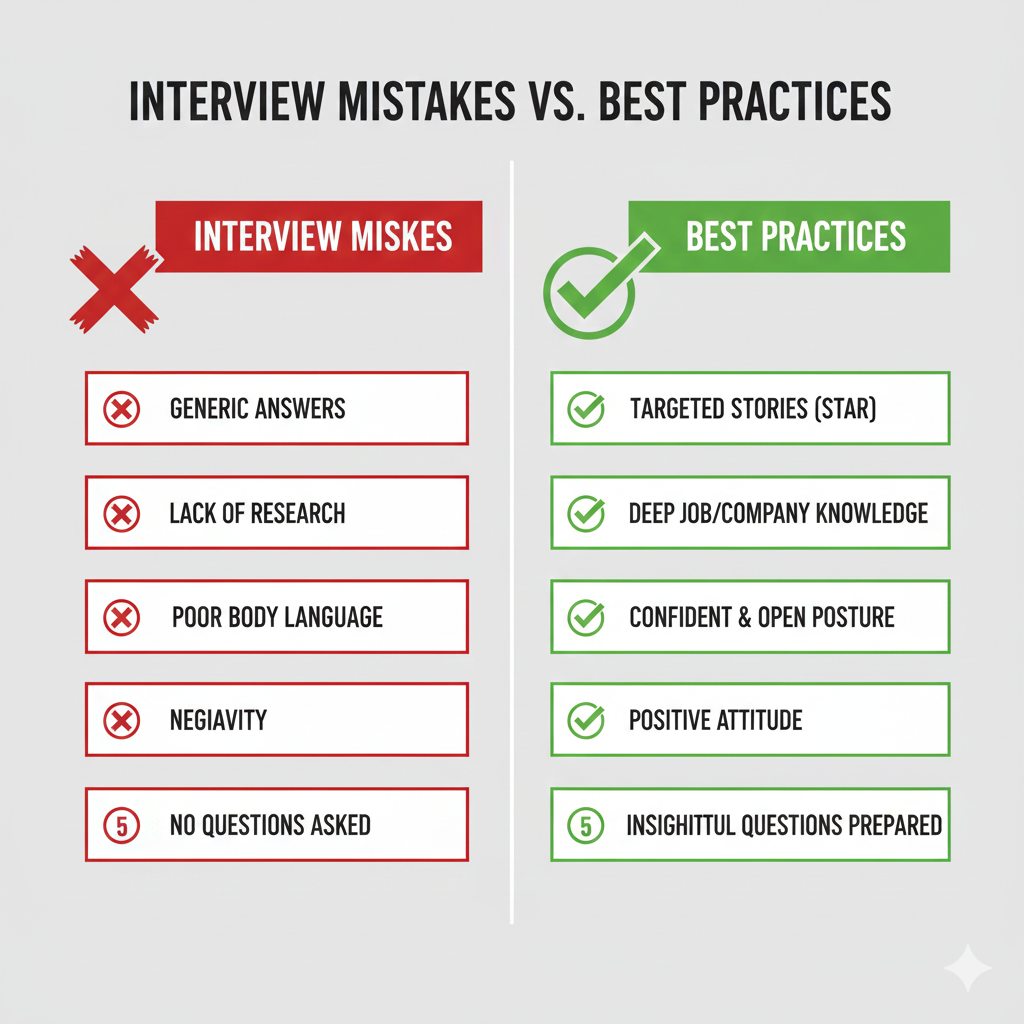
Common Interview Mistakes (And How to Avoid Them)
❌ Mistake #1: Answering questions you weren't asked
What happens: They ask "Tell me about a time you led a project" and you spend 5 minutes talking about a project where you were a contributor, not the leader.
Fix: Listen carefully to the actual question. If they ask about leadership, give a leadership example. If they ask about failure, share a real failure (not a humblebrag).
❌ Mistake #2: Talking too much
What happens: You give a 5-minute answer when 90 seconds would suffice. The interviewer starts glazing over.
Fix: Practice with a timer. Most answers should be 60-90 seconds. If they want more detail, they'll ask follow-up questions.
❌ Mistake #3: Bad-mouthing previous employers
What happens: When asked "Why are you leaving your current role?" you vent about your terrible boss, toxic culture, and incompetent coworkers.
Fix: Always frame it positively. "I'm looking for opportunities to [grow/lead/work on X], and this role offers that." Never trash talk previous employers, even if they deserve it.
❌ Mistake #4: Vague, generic answers
What happens: "I'm a hard worker who's passionate about technology and loves collaborating with teams to achieve results..."
Fix: Be specific. Use numbers, names, concrete examples. "I increased customer retention by 18% by implementing a new onboarding workflow that reduced time-to-value from 14 days to 6 days."
❌ Mistake #5: Not asking good questions
What happens: When they ask "Any questions?" you say "No, I think we covered everything" or ask about vacation policy.
Fix: Always have 5-7 thoughtful questions prepared. Ask about challenges, team dynamics, success metrics, growth opportunities.
The Day-Before Interview Checklist
24 hours before:
- ✓ Review your prepared questions (don't practice new ones)
- ✓ Test technology (Zoom link, camera, microphone, lighting)
- ✓ Prepare your environment (clean background, no distractions)
- ✓ Print copy of resume and job description (even for virtual)
- ✓ Prepare notebook for taking notes
- ✓ Choose and lay out your outfit
- ✓ Get the interviewer's name and title (check pronunciation)
- ✓ Research interviewer on LinkedIn (find common ground)
1 hour before:
- ✓ Review your "why this role" answer
- ✓ Review your closing statement
- ✓ Do a final tech check
- ✓ Use the bathroom
- ✓ Get water nearby
- ✓ Silence phone and notifications
- ✓ Take 5 deep breaths
During interview:
- ✓ Smile (even on phone calls - they can hear it)
- ✓ Take brief notes on their questions
- ✓ Ask for clarification if you don't understand a question
- ✓ It's okay to take 3-5 seconds to think before answering
- ✓ Watch for their cues (if they seem bored, wrap up your answer)
- ✓ End strong with your prepared closing statement
The AI-Powered Interview Prep Advantage
Here's what manual prep looks like:
- Guess which questions they'll ask (often wrong)
- Practice answers with no feedback (can't identify weaknesses)
- Self-evaluate (notoriously inaccurate)
- Hope you're ready (high anxiety)
Total time: 2-3 hours of uncertain preparation
Here's what AI-powered prep looks like:
- AI generates job-specific questions (based on actual job description)
- Practice with instant feedback (identifies weak spots)
- Get improvement recommendations (concrete fixes)
- Track readiness scores (know exactly where you stand)
Total time: 2-3 hours of targeted, effective preparation
Same time investment. Dramatically better results.
At Hiir.me, our interview prep system:
- Analyzes the job description you've saved
- Generates 5-8 tailored questions across all categories
- Lets you practice answers in a realistic interface
- Provides AI feedback on each answer's quality
- Identifies weak responses that need improvement
- Gives final interview tips based on your overall performance
This is Step 6 of our 7-step workflow. By the time you get to the interview, you've already:
- Optimized your resume for this job (ApplyScore)
- Built a tailored profile (modular system)
- Generated a personalized cover letter
- Sent a trackable application (know they viewed it)
- Followed up strategically (based on data)
Now you're practicing the actual questions with professional-level feedback.
Try it free: Your first 3 complete workflows (including interview prep) are free. No credit card required.
Real Scenarios: How This Works
Scenario 1: The Career Changer
Background: Emma is transitioning from teaching to corporate training. She's worried about "Tell me about your experience in corporate training" when she has none.
AI-generated questions flagged this concern:
- "How would you adapt your teaching experience to corporate audiences?"
- "What transferable skills from education apply to corporate training?"
Practice with AI feedback helped her:
- Reframe teaching experience as "instructional design and audience engagement"
- Emphasize data-driven approach (student outcomes = training KPIs)
- Address the concern proactively rather than defensively
Result: She got the offer. The hiring manager said "You clearly thought deeply about this transition."
Scenario 2: The Technical Interview
Background: David is interviewing for a Data Engineer role. He's technical but struggles explaining complex concepts simply.
AI-generated questions included:
- "Explain how you'd optimize a slow-running query to a non-technical stakeholder"
- "Walk me through your data pipeline architecture"
AI feedback on his practice answers:
- "Your explanation uses too much jargon for non-technical audiences"
- "Break down your architecture explanation into steps"
- "Add a real-world analogy for the pipeline concept"
Result: In the actual interview, he explained data pipelines using a "factory assembly line" analogy. The non-technical VP understood immediately and was impressed.
Scenario 3: The Behavioral Question Disaster (Avoided)
Background: Lisa practiced "Tell me about a time you failed" and prepared a story about missing a deadline.
AI feedback flagged issues:
- "Your answer focuses too much on external factors (blaming others)"
- "You don't clearly explain what you learned"
- "The result is vague - what actually happened?"
She revised her answer to:
- Take ownership of the mistake
- Explain specific lessons learned
- Show how she applied those lessons successfully later
Result: The interviewer said "I appreciate your honesty and self-awareness." She got the offer.
The Bottom Line
You don't get a second chance at a first interview.
Winging it doesn't work:
- You freeze on behavioral questions
- You ramble without structure
- You miss opportunities to highlight your strengths
- You leave thinking "I should have said..."
Generic prep doesn't work:
- You prepare for questions they don't ask
- You're unprepared for job-specific scenarios
- You sound rehearsed on common questions
- You're still guessing what they want to hear
Targeted, systematic prep works:
- You practice the actual questions you'll face
- You get feedback and improve weak answers
- You show up confident and prepared
- You land the offer
The difference between candidates who get offers and candidates who don't isn't talent.
It's preparation quality.
Start preparing systematically, and you'll see different results.
Your Interview Prep Action Plan
48 hours before interview:
- Analyze the job description deeply (30 minutes)
- Generate 5-8 job-specific questions (20 minutes)
- Practice answers out loud (90 minutes)
- Get feedback and refine (60 minutes)
- Prepare questions to ask them (15 minutes)
- Prepare your closing statement (10 minutes)
- Do final mock interview (30 minutes)
Total time: 4 hours
That's 4 hours that could determine whether you get a job offer worth $70,000+ per year.
Worth it? Absolutely.
The shortcut: Use AI-powered interview prep to do all of this in half the time with better results.
[Prepare for Your Next Interview →]
Frequently Asked Questions
Q: How many questions should I prepare for?
A: 5-8 questions covering technical, behavioral, situational, and culture fit categories. This covers 90% of what you'll be asked.
Q: Should I memorize my answers word-for-word?
A: No. Memorize the structure and key points, but let the delivery be natural. Memorized answers sound robotic.
Q: What if they ask a question I didn't prepare for?
A: It's okay to take 5 seconds to think. Use the STAR method for behavioral questions. For others, ask clarifying questions to buy time while you formulate your answer.
Q: How do I practice without someone to interview me?
A: Record yourself answering questions out loud. Use AI feedback tools to evaluate your answers. This is actually better than practicing with friends who aren't trained interviewers.
Q: What if I don't have good examples for behavioral questions?
A: You have more examples than you think. Review your entire work history, volunteer work, school projects, and personal projects. Even small examples work if you structure them well with STAR.
Q: Is it okay to take notes during the interview?
A: Yes! Taking brief notes shows you're engaged and organized. Just don't write so much that you lose eye contact or miss what they're saying.
Related Articles
- The Real Reason You're Not Getting Interview Callbacks - Why great candidates fail interviews
- How to Track Job Applications Like a Pro - Organize your entire job search
- The Complete 7-Step Job Search System That Actually Works - Full workflow from application to offer
- Follow-Up Email Templates That Actually Get Responses - What to send after the interview
Stop winging interviews. Start preparing systematically.
Get job-specific questions. Practice with AI feedback. Land the offer.
Last updated: November 25, 2025